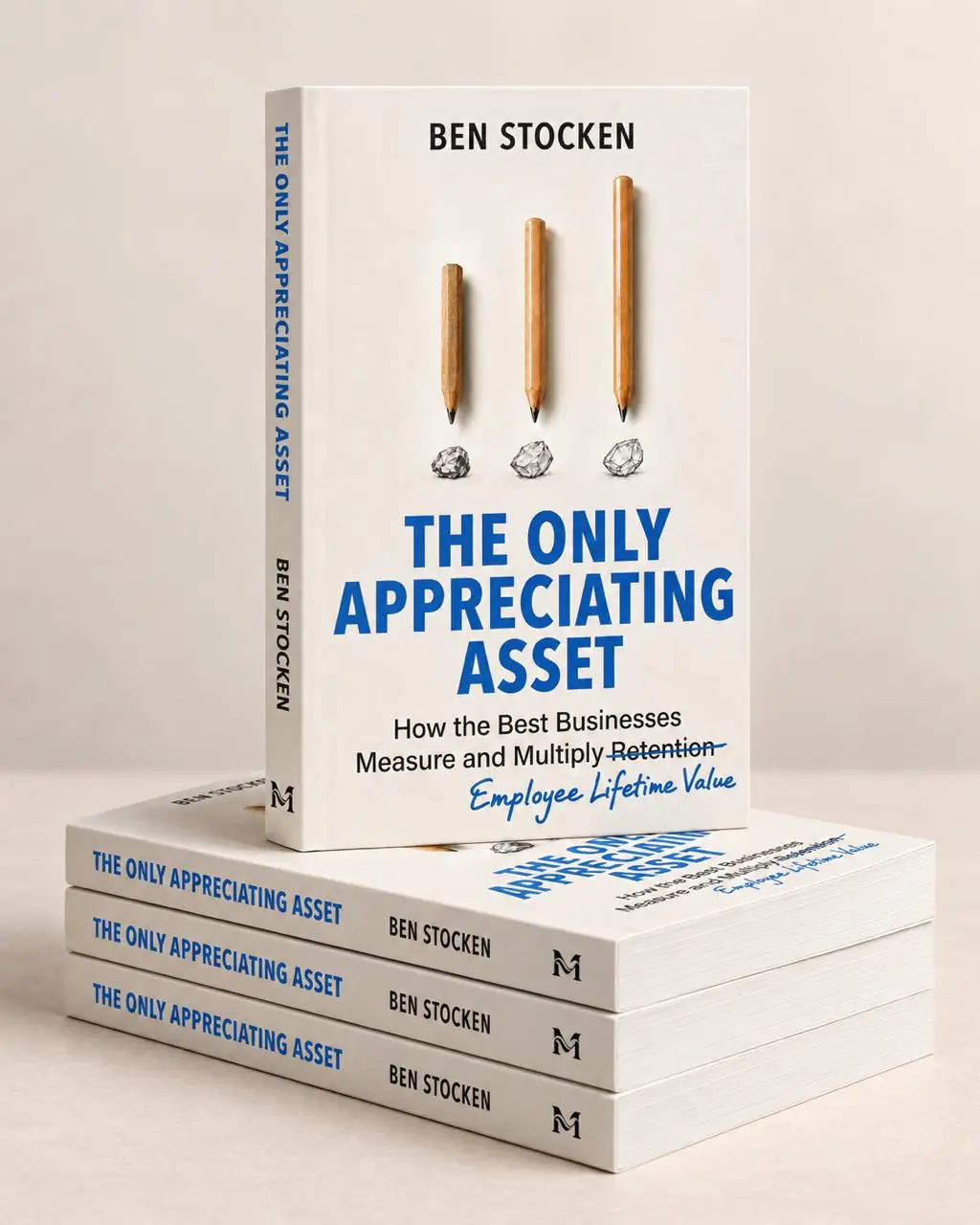
Ben StockenBEN STOCKEN
THE BOOK
THE READER COMPANION

THE ELV
PLAYBOOK

Turn human potential into enterprise value.

A practical companion to The Only Appreciating Asset. Diagnose one real team, identify where value is leaking and choose what to change next.

Free to use. No account required. Your work is saved only in this browser.

The Only Appreciating Asset by Ben Stocken
01
YOUR WORKING SESSION

Four stages. One clearer view of value.

Work through the stages in order. Score the system around one team or function, never an individual. You will finish with a team diagnosis, a rough value-leak estimate and three moves you can start on Monday. Then use Atherio's ELV Index to measure and track the whole organisation.

01

SEE IT

Make the invisible visible. Define where potential is appreciating and where it is being lost.

5 SCORED STATEMENTS · /25
02

MEASURE IT

Draw the ELV Arch, estimate the value leak and replace vague signals with useful evidence.

5 SCORED STATEMENTS · /25
03

BUILD IT

Strengthen the system that converts human potential into sustained contribution.

5 SCORED STATEMENTS · /25
04

RUN IT

Put ELV into the operating rhythm, management conversations and board decisions.

5 SCORED STATEMENTS · /25
THE INTERACTIVE PLAYBOOK

Choose one real team.

Specific beats grand. Work through the four stages in order and answer honestly. If you cannot see an answer from where you sit, that is a finding too.

Score each statement from 1, not true here, to 5, true and supported by evidence. Direction of travel matters more than the decimal point.

01
STAGE ONE

See It

You cannot manage what you cannot see. Before you measure anything, look at the reps, decisions, promotions and metrics around one team.

Ask yourself

  1. How many times each week do managers actually lead, delegate, give feedback or hand back a decision? When was one last coached on how they did it, rather than only on what they delivered?
  2. Take your last board pack. Which people numbers tell you what already happened, and which tell you what to change next?
  3. Where does a person appear in your accounts? Name one person whose value has visibly compounded over two years. Could you prove it to a CFO?
  4. If managers described their real job privately, would they talk about controlling output or making their people more valuable?
  5. Review the last five management promotions. How many rewarded individual brilliance and how many rewarded making other people better?
  6. Where do good decisions wait for someone senior to enter the room?
STRONG SIGNAL

You can point to specific reps, name a team that runs without its manager and distinguish leading measures from lagging outcomes.

WARNING SIGN

Every people number is a lagging outcome, and “How are the people?” is answered with an attrition figure.

Can you see it?

I can name the handful of reps that make or break performance in this team.

3

I know which people metrics are lagging outcomes and which, if any, are leading behaviours.

3

I can name where decisions wait for someone senior, and at least one has been handed back.

3

I have reviewed the last five management promotions and know how many went to people who make others more valuable.

3

I can name one team that runs through its manager and one that runs without them.

3
STAGE ONE SCORE15 / 25

It exists, but it depends on who is in the room.

02
STAGE TWO

Measure It

Employee Lifetime Value is the share of people’s potential the business converts, read as an aggregate and never as a rank. Rough and real beats precise and invented.

Ask yourself

  1. Draw the team’s ELV Arch. How long and costly is A before contribution? How high and long is B? How steep is C at the end?
  2. What is the smallest honest unit at which you will read conversion: team or function? It is never the person.
  3. Name three conditions you can watch this quarter: speed to contribution, speed of feedback and whether decisions are handed back or hoarded.
  4. Compare this team with the best similar team, or its own best quarter. What share of potential output is not being converted?
  5. If a buyer acquired the business tomorrow, how would they measure your people, and what would they miss?
THE ELV ARCH
The Employee Lifetime Value ArchA classic employee lifetime value curve. It begins well below the value line during hiring, onboarding and the slower ramp to productivity in A. It rises into sustained productive contribution in B, then declines through disengagement, transition and exit in C.ABCHIRING + RAMP COSTTO CONTRIBUTIONPRODUCTIVE VALUECREATED OVER TIMEDECLINE +EXIT COSTVALUE CREATED / COSTTIME WITH THE BUSINESS

ELV = B − A − C

Map the full hiring, onboarding and ramp cost in A, sustained productive contribution in B, and the decline, transition and exit cost in C.

ROUGH ANNUAL LEAKAdd the two figures
STRONG SIGNAL

You can draw the arch, locate the widest gap and put a rough cash figure on the leak without ranking people.

WARNING SIGN

Your first instinct is to score individuals, and you cannot estimate the cost of unconverted potential.

Can you measure it?

I have drawn this team’s arch and can describe A, B and C.

3

We read conversion at team or function level, never to rank individuals.

3

We have named three leading behaviours or conditions, and someone is watching them.

3

I have estimated this team’s cash leak, including anywhere retention is hiding it.

3

We have traced at least one “How did you achieve that?” thread to a repeatable behaviour.

3
STAGE TWO SCORE15 / 25

It exists, but it depends on who is in the room.

03
STAGE THREE

Build It

Audit the machine that turns potential into contribution: how managers are made, how leadership is coached and where the record of development lives.

Ask yourself

  1. What is your verdict window between someone checking out and the business noticing? Where are managers rescuing rather than building?
  2. Do people apply for management through a gate and receive deliberate investment? What can a manager do at day 90 that they could not do on day one?
  3. Do managers share the same language for delegation, feedback and the hand-back? Who owns the one-to-one, and where does the record live?
  4. Is growth being created by the machine or hidden by the market? Hold headcount and the market flat on paper. What would people still produce?
STRONG SIGNAL

Managers pass through a gate, share one language and can show new capability at day 90 in a written record.

WARNING SIGN

Management rewards tenure, every manager speaks a private dialect and leadership leaves no trace.

Are you building it?

We know our verdict window and would notice a disengaged person inside it.

3

Management is applied for through a gate, not awarded for tenure, and experienced hires go through it too.

3

Managers share one performance language built from our own words.

3

The person owns the one-to-one, and a Single Source of Truth records how each person is led.

3

We have tested whether growth comes from the machine or the market, and we are comfortable with the answer.

3
STAGE THREE SCORE15 / 25

It exists, but it depends on who is in the room.

04
STAGE FOUR

Run It

Turn the argument into an operating rhythm: the three Monday moves, the board page and a portfolio of fast and compounding investments.

Ask yourself

  1. Run the three Monday moves. Ask whether every person became more valuable, count one-to-ones scheduled, run and recorded, then audit the last five management promotions.
  2. If Lead is the largest lever, does the allocation of development budget, senior attention and your best people’s time reflect it?
  3. Could you produce one page showing conversion by function, direction of travel and the one change that moved it?
  4. Where is conversion rising? Where is potential leaking at full salary? Where will the next investment pay back fastest and longest?
  5. Name one fast-payback move and one slow, compounding move. Are both funded?
  6. Are people paid back financially, psychologically and physiologically, or only through the payslip?
01

Ask every manager whether each person became more valuable this quarter, and require evidence.

02

Count the one-to-ones scheduled, actually run and recorded.

03

Audit the last five management promotions: prize or profession?

STRONG SIGNAL

The people page goes first, spend is weighted toward Lead and fast and slow-compounding moves are funded together.

WARNING SIGN

The people item is last, investment ignores the biggest lever and no team has a rough ELV Index.

Are you running it?

The three Monday moves have been completed and the findings are written down.

3

Investment in people is visibly weighted toward Lead because the manager is the biggest lever.

3

We can produce a one-page view of conversion by function and its direction of travel.

3

The people page goes first and the three board questions are asked of it.

3

We fund at least one fast-payback move and one slow-compounding move at the same time.

3
STAGE FOUR SCORE15 / 25

It exists, but it depends on who is in the room.

YOUR TEAM SCORECARD

A starting line, not a verdict.

Capture this team's four-stage diagnosis and rough annual value leak. Use Atherio for the tracked organisational Index.

SEE IT15 / 25
MEASURE IT15 / 25
BUILD IT15 / 25
RUN IT15 / 25
ROUGH LEAKNot entered
Thank you! Your submission has been received!
Oops! Something went wrong while submitting the form.
NEXT: MEASURE THE WHOLE ORGANISATION

Turn this team diagnosis into a tracked ELV Index.

You have examined one team in depth. Continue on Atherio to measure the whole organisation in 24 questions, taking under ten minutes.

You will receive an ELV score out of 100, an eight-pillar profile, your principal leakage risks and the highest-return opportunity to address next.

CONTINUE ON ATHERIO Get your tracked organisational score.TAKE THE ELV INDEX ON ATHERIOFree · 24 questions · Under 10 minutes
02
YOUR PLAYBOOK TOOLS

Keep the useful parts close.

!
Use ELV responsibly.

This is a practitioner calibration tool for teams and functions. It is not a validated instrument, an accounting valuation or a way to score individual people.

MEASURE THE WHOLE ORGANISATION

What is your organisation actually converting?

Take the tracked ELV Index on Atherio for your organisational score, eight-pillar profile and highest-return opportunity.

TAKE THE ELV INDEX